
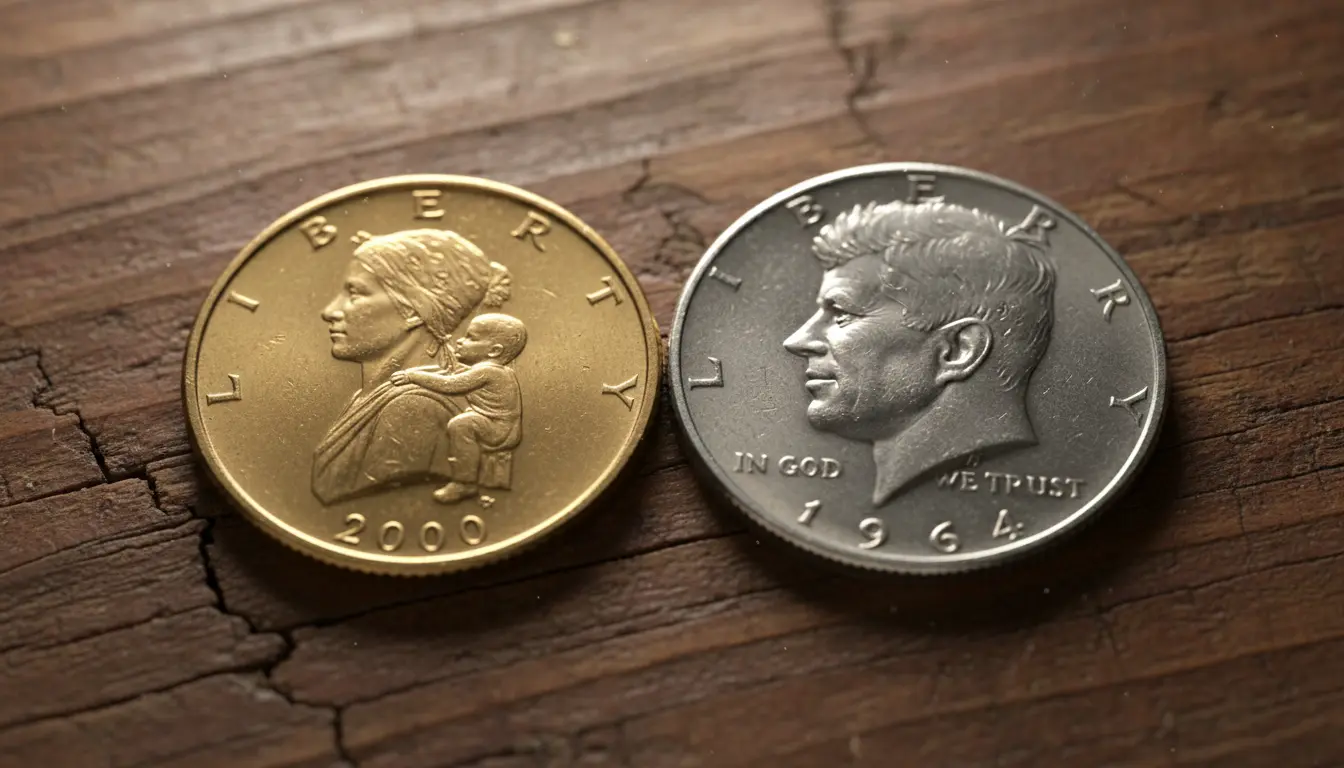
The Sacagawea Dollar and the Kennedy Half Dollar are two popular modern U.S. coins that appeal to different types of collectors. Choosing between them depends on your goals, budget, and interest in history or metal content.
Sacagawea Dollar vs Kennedy Half Dollar: Quick Comparison
This comparison highlights the main differences you should consider when deciding what to collect. It covers availability, intrinsic value, historical appeal, and typical collector demand.
- Face value and size: Sacagawea = $1, small and gold-colored; Kennedy = 50 cents, larger and silver-colored (post-1971 copper-nickel clad).
- Metal content: Sacagawea coins are manganese-brass over a copper core; most modern Kennedys (post-1971) are copper-nickel clad, while 1964 Kennedys are 90% silver and 1965-1970 are 40% silver.
- Historical interest: Sacagawea honors a Native American guide to Lewis and Clark; Kennedy celebrates President John F. Kennedy.
- Market value: Common circulated examples of both are typically close to face value, but specific dates, mintmarks, proofs, and errors can raise values significantly.
Sacagawea Dollar: What to Know
The Sacagawea Dollar was introduced in 2000 and features Sacagawea carrying her infant on the obverse. The coin was intended for daily circulation and to replace the unpopular Susan B. Anthony dollar.
Most Sacagawea dollars are common and inexpensive. Collectors usually target special issues like proof sets, business strike mint sets, and notable error coins.
Pros of collecting Sacagawea Dollars
- Affordable entry cost for most dates and mint marks.
- Colorful gold appearance fits display sets well.
- Many modern commemorative versions and reverse designs to pursue.
Cons of collecting Sacagawea Dollars
- Limited intrinsic metal value.
- Large mintage numbers make many dates common.
- Less interest from investors seeking precious metals.
Kennedy Half Dollar: What to Know
The Kennedy Half Dollar debuted in 1964 after President Kennedy’s assassination. Early issues carry significant collector and metal interest because of their silver content.
Collectors focus on silver Kennedys (1964, and 1965-1970 varieties), low-mintage proof coins, and key errors or mintmarks that affect rarity.
Pros of collecting Kennedy Half Dollars
- Silver Kennedys have intrinsic metal value and stronger collector demand.
- Many dates and varieties make the series interesting over time.
- Larger size displays well in albums and frames.
Cons of collecting Kennedy Half Dollars
- Post-1971 coins have little intrinsic metal value beyond face value.
- High-mintage modern issues can be common and less exciting.
- Complete high-grade sets can be costly if focusing on early silver dates.
How to Choose: Goals, Budget, and Interest
Your collecting goal should drive the choice between Sacagawea Dollars and Kennedy Half Dollars. Think about whether you want a low-cost starter set, a silver-based collection, or a thematic historical series.
Collector goals and recommendations
- Beginner on a budget: Start with Sacagawea dollars. You can assemble attractive sets without heavy investment.
- Investor or silver seeker: Focus on Kennedy halves from 1964 and 1965-1970 for silver content and intrinsic value.
- Historical or thematic collector: Choose based on which story appeals to you: Lewis and Clark and Native American history for Sacagawea, or modern presidential history for Kennedy.
- Error and variety collector: Both series have error coins; research specific error types and certified examples before buying.
Practical Tips for Collecting
Follow these practical steps to build a satisfying collection without overspending. Focus on condition, authenticity, and documented provenance when possible.
- Buy certified coins for key dates or expensive pieces to avoid counterfeits.
- Use coin albums and proper holders to keep coins in collectible condition.
- Compare prices at local coin shops, online marketplaces, and auction sites before buying.
- Attend coin shows to see coins in hand and ask experienced collectors for advice.
The 1964 Kennedy half dollar is 90% silver and was struck in large numbers, but many were hoarded for their silver content, making high-grade examples harder to find in circulation.
Case Study: A Beginner Collector’s Choice
Maria, a new collector, had $200 to start a collection and liked American history. She visited a local coin shop and a show to compare options.
With her budget she bought a set of uncirculated Sacagawea dollars from several mints and one certified 1965 Kennedy half in very fine condition. The Sacagawea set gave her variety and an attractive display, while the single Kennedy half satisfied her interest in silver-era Kennedy coins without overreaching her budget.
This mixed approach allowed Maria to enjoy both series and learn about grading, mints, and market prices before committing to more expensive pieces.
Final Recommendation: Which Should You Collect?
Choose the Sacagawea Dollar if you want an affordable, visually consistent series with many modern design options and a low-cost entry point. Choose the Kennedy Half Dollar if you value silver content, presidential history, or want a series with early issues that hold intrinsic metal value.
Many collectors mix both: start with Sacagawea for variety and add key Kennedy silver pieces as your budget grows. Define your collecting goals, and let those goals guide purchases rather than trends or hype.
Whatever you choose, collect coins that you enjoy looking at and learning about. The best collections reflect the collector’s interests and grow over time with knowledge and careful purchases.