
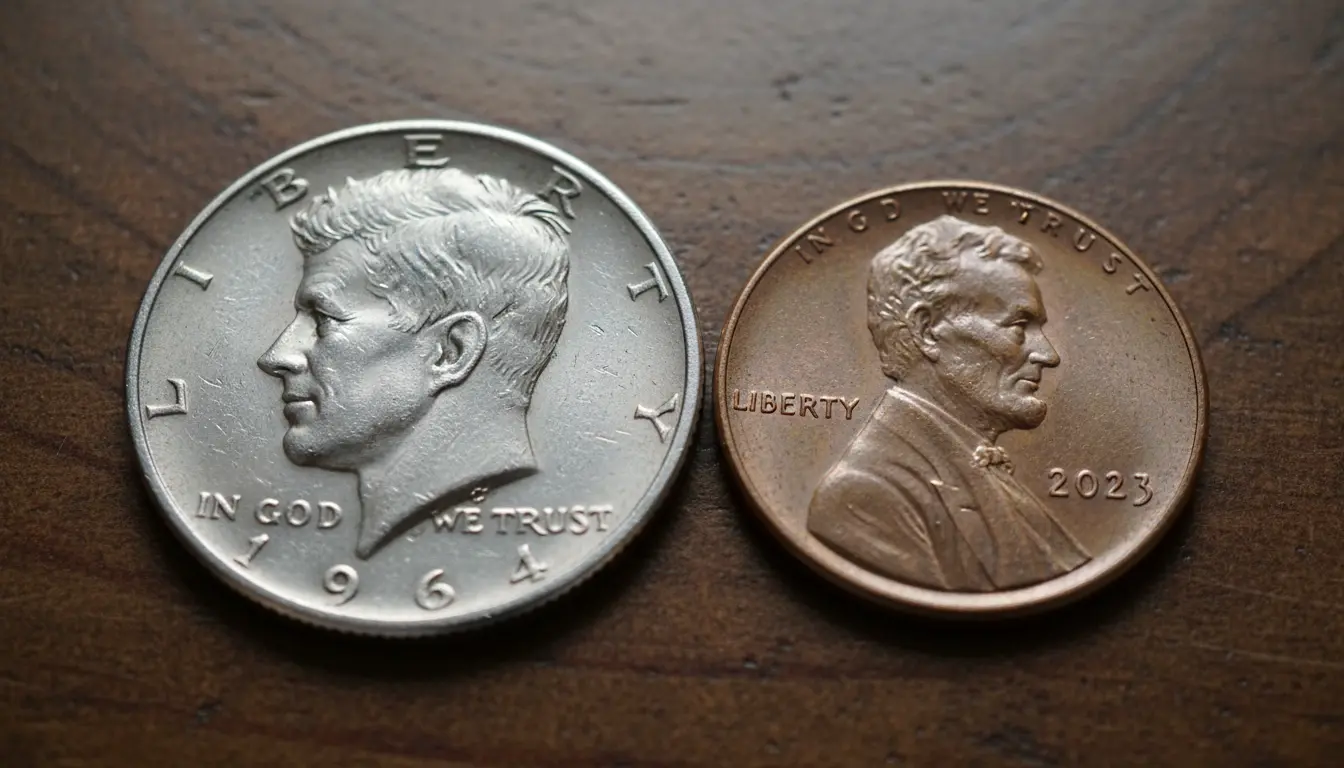
Deciding between the Sacagawea Dollar and the Kennedy Half Dollar comes down to history, metal content, and the type of collecting you enjoy. This guide compares both coins so you can choose with confidence.
Sacagawea Dollar vs Kennedy Half Dollar: Quick Overview
The Sacagawea Dollar debuted in 2000 as a gold-colored one-dollar coin. It features a portrait of Sacagawea carrying her infant son on the obverse and has had changing reverse designs over the years.
The Kennedy Half Dollar was introduced in 1964 shortly after President John F. Kennedy’s assassination. Its classic portrait and strong connection to 1960s history make it a favorite among collectors.
History and Design
Sacagawea Dollar history
Launched to replace the Susan B. Anthony dollar, the Sacagawea Dollar offers modern imagery and a distinctive golden tone. Designers aimed for a coin that would be easy to identify in circulation.
Kennedy Half Dollar history
The Kennedy Half Dollar was authorized in 1964 to honor JFK. Early issues were struck in silver, and the coin quickly became a symbol of 1960s America and presidential numismatics.
Composition and Key Dates
Composition affects value and interest. Know the basic metal differences before collecting either coin.
- Sacagawea Dollar: Gold-colored manganese-brass clad composition; introduced in 2000 and used in commerce and collector sets.
- Kennedy Half Dollar: 1964 coins are 90% silver. From 1965–1970 the coin used 40% silver. Since 1971 the Kennedy half has been copper-nickel clad.
Collectability: Sacagawea Dollar vs Kennedy Half Dollar
Both coins have collecting niches. Your interest in modern errors, circulated finds, or historic silver will influence your choice.
Why collect Sacagawea Dollars?
- Distinctive look that stands out in a collection.
- Many date-and-mint combinations and occasional special issues or errors.
- Affordable for beginners; most common dates are near face value in circulated condition.
Why collect Kennedy Half Dollars?
- Silver content in 1964 and 1965–1970 issues attracts bullion and historical collectors.
- Large collector base and many proof or uncirculated sets.
- Older key dates and high-grade examples can be valuable.
Value Drivers for Each Coin
Values depend on scarcity, condition, metal content, and demand. Here are practical pointers to spot higher-value pieces.
- Silver content: Kennedy halves from 1964 and 1965–1970 have intrinsic value tied to silver prices.
- Condition: High-grade, uncirculated, or certified coins command premiums.
- Errors and rare varieties: Both series have error coins or low-mintage proofs that can be worth more than face value.
Practical Tips: Which Coin Sparks Your Collection?
Choose by collecting goal. Are you building a historical set, focusing on precious metals, or looking for colorful modern coins?
- If you want precious metal exposure and history, focus on Kennedy halves from the 1960s.
- If you prefer modern circulation pieces and variety of designs, start with Sacagawea dollars.
- If budget is limited, Sacagawea dollars offer more variety for smaller spend; silver Kennedys cost more but have resale value tied to metal prices.
How to Start Collecting: Practical Steps
Start small and learn. Follow a few practical steps to build a satisfying collection without overspending.
- Decide focus: date sets, mint marks, proofs, or error coins.
- Buy reputable: dealers, coin shows, and auction sites with good seller ratings.
- Protect coins: use holders, flips, or albums and store in a cool, dry place.
- Learn grading basics; consider third-party grading for high-value pieces.
Small Case Study: Beginner to Confident Collector
A beginner named Alex started by buying a mixed lot of modern dollars for $30. Over time Alex separated Sacagawea dollars from other pieces and learned to spot proof sets. After a year Alex traded two high-grade Sacagawea proofs toward a 1968 Kennedy half in excellent condition. The trade deepened Alex’s interest in silver-era halves and expanded the collection into both modern and historic areas.
Where to Buy and What to Avoid
Buy from local coin shops, established online dealers, and reputable auction houses. Avoid sellers with vague photos, no return policy, or prices that seem too good to be true.
- Good sources: coin shows, certified dealers, ANA-affiliated shops.
- Watch for: cleaned coins, altered surfaces, or misrepresented grades.
The Kennedy Half Dollar was produced in large quantities as a collector item after circulation demand dropped, making many modern halves primarily available through mint sets rather than pocket change.
Final Recommendation
Both coins are rewarding to collect. Pick the Sacagawea Dollar for modern design variety and lower entry cost. Choose the Kennedy Half Dollar for historic appeal and silver-era value.
Use the tips above to begin. Over time you can mix both series for a collection that shows the breadth of late 20th-century U.S. coinage.