
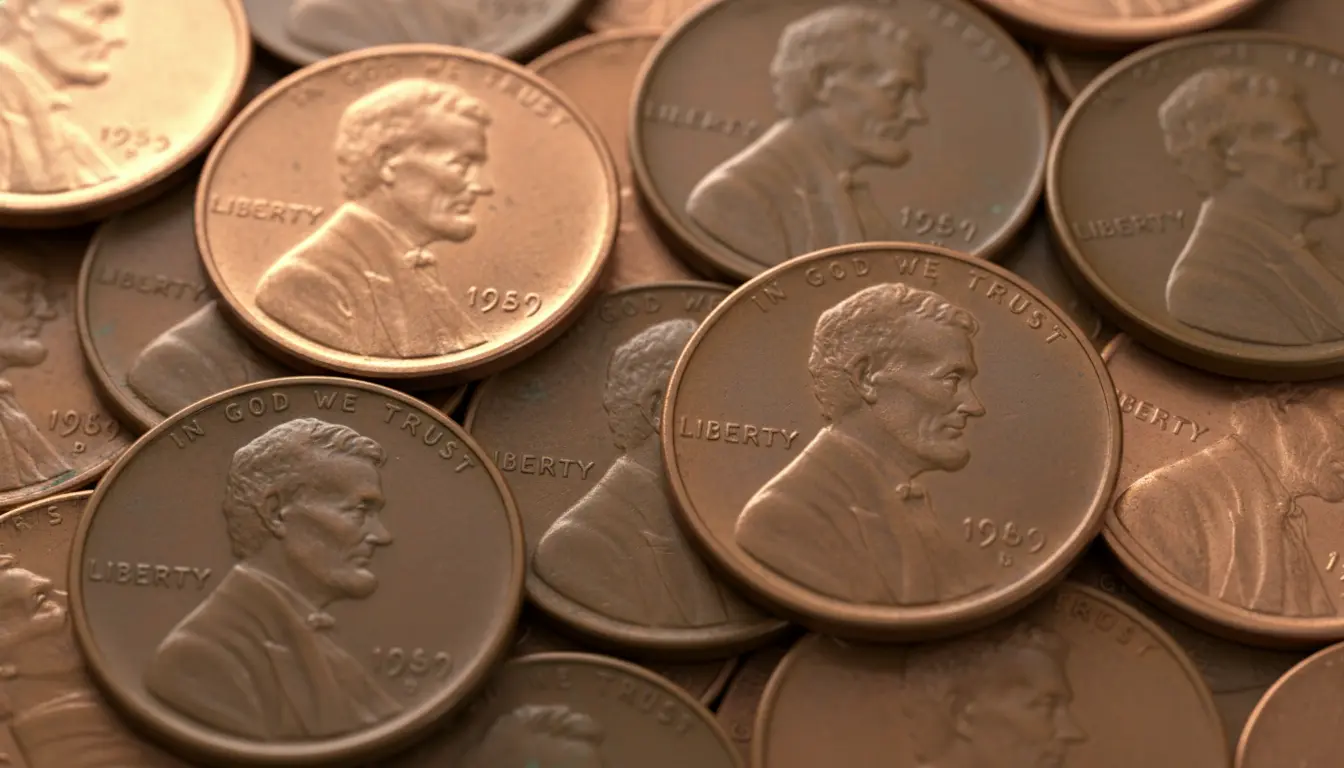
Many rare Lincoln pennies still turn up in everyday pocket change. Knowing which dates and errors are valuable will help you spot coins worth far more than face value.
Most Valuable Lincoln Pennies to Watch For
Focus on a handful of well-known dates and error types. These are the coins that most often appear in price guides and auction records.
- 1909-S VDB — The first year of the Lincoln cent with designer initials VDB on the reverse, struck at San Francisco. Very scarce in higher grades.
- 1909-S (no VDB) — A separate early 1909 San Francisco issue without the VDB initials can also be valuable when in good condition.
- 1914-D — A key Denver issue with low mintage; high-grade pieces demand premiums.
- 1922 Plain (no D) — Some 1922 cents show no mintmark and can be rare errors when genuine.
- 1943 Copper Cent — Most 1943 cents were struck in steel; a genuine 1943 bronze/copper cent is extremely rare and highly sought after.
- 1955 Doubled Die Obverse — A dramatic doubled die on the obverse produces doubled features that are easy to spot without magnification.
Other Valuable Varieties
Keep an eye out for repunched mintmarks (RPM), off-center strikes, and broadstrikes. These error coins can also carry significant value depending on severity and rarity.
How to Identify Valuable Lincoln Pennies
Start with a simple visual inspection using a magnifier and bright light. Look for dates, mintmarks, and obvious doubling or misstrikes.
Key steps:
- Check the date area carefully for 1909, 1914, 1922, 1943 and 1955.
- Look for mintmarks under the date (D or S) or absence of a mintmark where one is expected.
- Inspect for doubling on the date and letters—doubled dies show clear second images.
- Compare suspect coins to reputable photos online or in a price guide.
Basic Grading Tips for Lincoln Pennies
Condition strongly affects value. Even rare dates in worn, corroded or cleaned condition may be worth little above face value.
- Grades from Good (G) to Extremely Fine (XF) are mostly about wear; look for smooth high points.
- About Uncirculated (AU) coins keep some luster and detail; these carry better values.
- Mint State (MS) coins show full detail and no wear; these achieve the highest prices.
Never clean a potential rare coin. Cleaning often reduces value dramatically by altering the surface.
Some 1943 pennies struck on bronze planchets were accidental survivors from prior years. These 1943 copper cents have sold for tens of thousands to over one hundred thousand dollars depending on grade and provenance.
Where to Get a Suspect Penny Authenticated
If you think you have a valuable Lincoln penny, the next step is professional authentication. Third-party grading services provide reliable opinions and protect buyers and sellers.
- Major services: PCGS and NGC are the most trusted for United States coins.
- Local coin dealers can give an initial opinion but always seek third-party grading for high-value finds.
- Auctions and reputable online marketplaces often accept only graded coins for high-value lots.
How Authentication Works
A grading service verifies the coin’s date, mint, and any error and assigns a grade. The coin is then sealed in a tamper-evident holder with a label.
Certification helps realize top market prices and gives buyers confidence in the coin’s authenticity.
Where to Sell or Trade Valuable Lincoln Pennies
Choose the sales channel based on expected value and convenience. For very valuable coins, auctions or specialists often achieve the best prices.
- Local coin shops or shows are convenient for small to medium values.
- Online auction houses and specialized coin auction platforms are best for high-value rarities.
- Consignment through an auction house can maximize exposure and final sale prices.
Practical Steps to Check Your Pocket Change
Set aside time to quickly sort through coins. Use a loupe or phone camera macro mode to inspect dates and doubling.
- Separate pennies by decade and look for the key years listed earlier.
- Examine each suspect under a magnifier at 10x to 20x power.
- Photograph coins and compare to trusted reference images before seeking professional advice.
Common Mistakes to Avoid
- Do not clean coins to make them look better; cleaning reduces value.
- Ignore dealer buy-and-sell hype; get a second opinion for high-value claims.
- Don’t assume a dark or shiny coin is rare—composition and date matter most.
Real-World Example: A Pocket Change Find
A collector in Ohio found a worn 1955 penny among change and noticed heavy doubling in the date and letters. After photographing and comparing with online references, they took the coin to a local dealer who recommended submitting it for third-party grading.
The coin was confirmed as a genuine 1955 doubled die obverse and graded, leading to a sale that covered the grader fee and delivered a substantial premium over face value. The find shows how careful inspection and professional verification convert a pocket-change discovery into real value.
Final Tips for New Collectors
Start by learning the key dates and common errors, and handle coins by the edges. Use credible references and don’t rush to sell before authentication.
Regularly checking pocket change is a low-cost way to learn and occasionally find a valuable coin. With patience and the right steps, one of the coins in your pocket could be worth much more than a cent.