
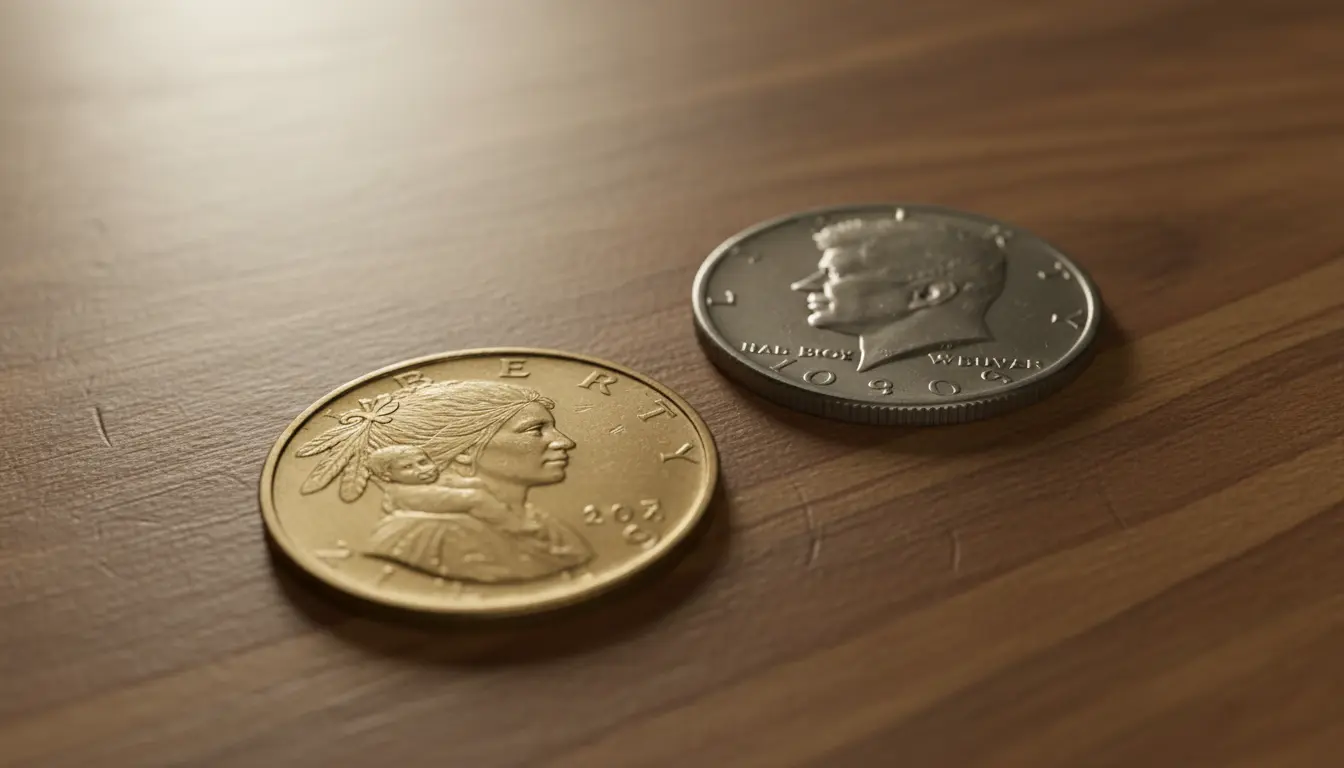
Sacagawea Dollar vs Kennedy Half Dollar: Quick Comparison
This guide helps collectors weigh the Sacagawea Dollar against the Kennedy Half Dollar. You will get practical points about history, metal content, common values, and collecting goals.
History and design of the Sacagawea Dollar
The Sacagawea Dollar debuted in 2000 as a modern one-dollar coin. Its obverse features Sacagawea carrying her infant, and the reverse has seen several state and national designs over the years.
Designed for circulation, this golden-colored dollar is widely available. Collectors focus on early issues, proof sets, and any mint errors or low-mintage varieties.
History and design of the Kennedy Half Dollar
The Kennedy Half Dollar was introduced in 1964 as a memorial to President John F. Kennedy. The obverse shows Kennedy’s profile and the reverse originally pictured the presidential coat of arms.
Early Kennedy halves (1964) are 90% silver, with 1965–1970 struck in 40% silver. From 1971 onward they are copper-nickel clad. That silver content is a major factor for collectors and investors.
Materials and how material affects value
Material matters. Sacagawea Dollars are a manganese-brass outer layer over a copper core; they have no intrinsic precious-metal value. Their worth comes from condition, rarity, and demand among collectors.
Kennedy Half Dollars can have intrinsic metal value when they contain silver. A 1964 half is 90% silver and typically commands more than face value from both collectors and silver buyers.
Key material points
- Sacagawea Dollar: modern alloy, golden look, collectability driven by mint marks, varieties, and condition.
- Kennedy Half Dollar: 1964 (90% silver), 1965–1970 (40% silver), 1971–present (clad). Silver content increases minimum value for older pieces.
Rarity, varieties, and where to look
Look for specific varieties and mint marks. Sacagawea collectors chase special minting years and proofs. Some early Sacagawea pieces, like the 2000-P or 2000-D with certain finish types, draw attention when in high grade.
Kennedy collectors search for errors, proof sets, and silver examples. Low-mintage proof half dollars and uncirculated coins in original mint packaging can be more desirable.
Practical value ranges and expectations
Expect realistic prices. Most circulated Sacagawea Dollars are worth face value to a few dollars each. Highly graded or scarce varieties will fetch higher prices from collectors.
For Kennedy halves, post-1970 clad coins are usually worth face value unless in gem or proof condition. Silver Kennedys typically sell above face value based on current silver prices and collector demand.
Which coin should you collect? Sacagawea Dollar vs Kennedy Half Dollar
Decide by your collecting goals. If you want a modern, light-weight collection with thematic artwork, Sacagawea Dollars are attractive and affordable to assemble.
If you prefer coins with precious metal potential or historical relevance, Kennedy Half Dollars — especially silver issues — are a better fit. They carry both numismatic and bullion interest.
Choose Sacagawea Dollar if:
- You want a color-distinct modern coin easy to find.
- You plan to collect state or national reverse designs.
- You prefer lower entry cost per piece for graded sets.
Choose Kennedy Half Dollar if:
- You value silver content and historical significance.
- You enjoy hunting for proof sets and higher-grade vintage pieces.
- You want a mix of bullion and numismatic appeal.
How to start collecting either coin
Begin with a clear goal: build a date-and-mint set, target proofs, or collect error coins. Decide on a budget and grade threshold before buying.
Useful steps:
- Buy certified coins from reputable dealers for higher-value pieces.
- Use coin folders or inert plastic flips for storage.
- Track purchases and keep receipts for provenance.
Practical tips for buying and grading
Learn basic grading terms: uncirculated, proof, mint state (MS), and circulated. Grading affects price dramatically for both Sacagawea and Kennedy halves.
Attend local coin shows, use online marketplaces, and consult price guides to compare offers. For silver Kennedy halves, compare seller price to spot silver and grading premium.
Case study: A beginner’s two-year plan
Case study: Maria, a new collector, started with a $300 budget. She decided to focus on Sacagawea Dollars and a few Kennedy silver halves.
Over two years she bought 120 Sacagawea Dollars from rolls and online, selecting 15 in near-uncirculated condition. She also acquired three 1964 Kennedy halves graded by a reputable service. Her collection balance gave her both a thematic set and silver-backed value.
This approach let Maria learn grading basics, build storage habits, and understand market pricing without overspending.
Final checklist: choosing between Sacagawea Dollar and Kennedy Half Dollar
- Decide if you want modern design variety (Sacagawea) or historical silver content (Kennedy).
- Set a budget and what grade range you will accept.
- Research key dates and mint marks before buying.
- Consider certification for higher-value coins.
Both the Sacagawea Dollar and the Kennedy Half Dollar have strong collecting appeals. Your choice should reflect whether you prioritize modern design and wide availability or historical depth and silver content. Start small, learn grading, and enjoy building a collection that matches your interests.